View the online publication we released for the 20th anniversary of the painting competition Maľba.


Jakub Ružinský
(*1996, Košice)
Merry-go-round
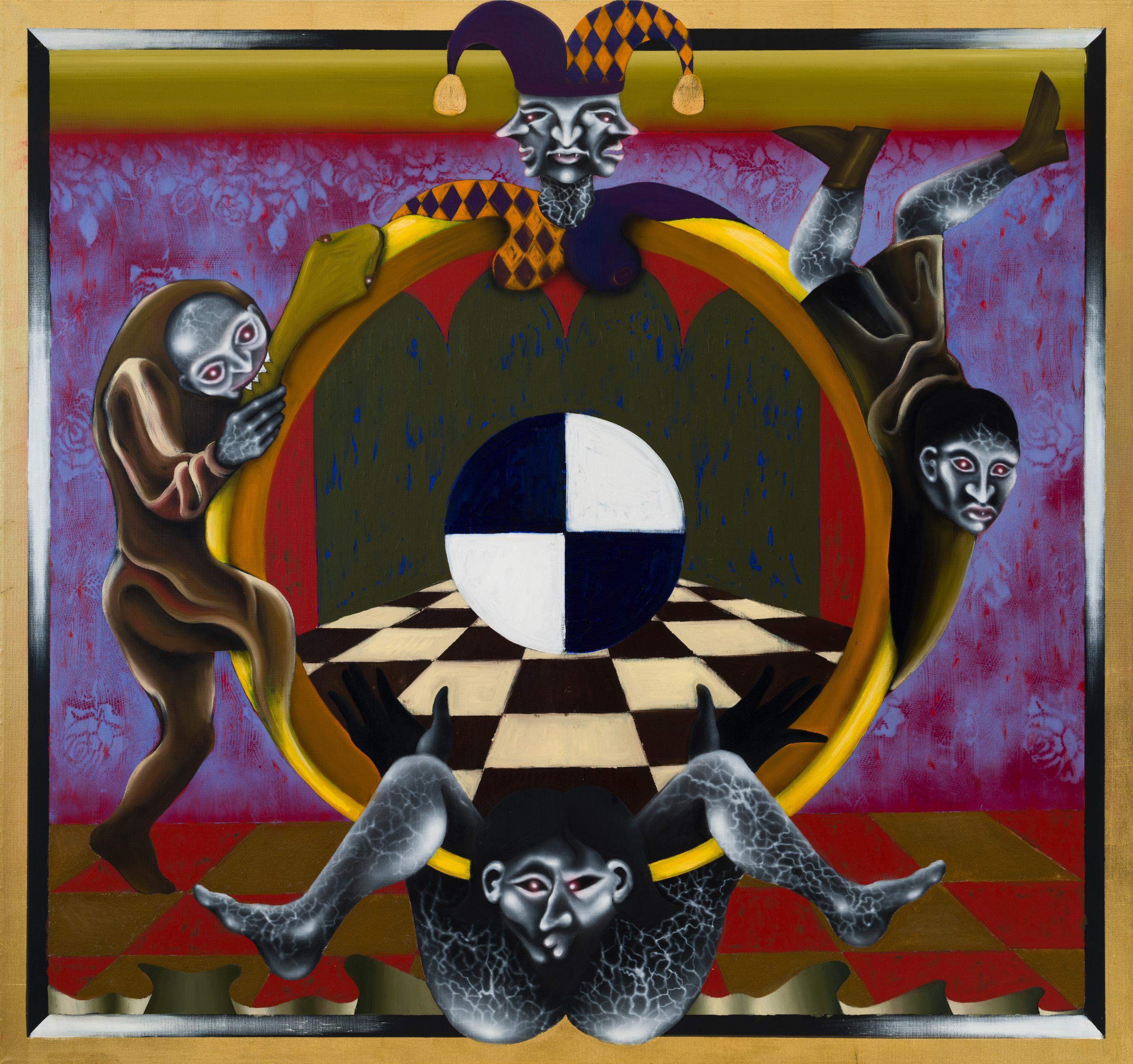
2026, mixed media, (acrylic, airbrush, sheet metal, oil) on canvas, 150 x 160
2017 – 2023, studied at the Faculty of Arts in Ostrava University in Painting Studio I, led by Prof. Daniel Balabán. 2012 – 2016, he completed study at the School of Applied Art, Košice, in the Department of Conservation and Restoration. 2024, won 3rd Prize in the 17th annual Critics’ Prizes for Young Painting (Galerie Kritiků, Praha). 2026, he is a finalist in the Painting Competition.
Jakub Ružinský, a debutant in the competition, has long been artistically engaged with collective memory, visual archetype and narrative. Via images of the world constructed in collage, he tests the perceptiveness of the contemporary world. His complex figural compositions incorporate historical references and draw inspiration from medieval iconography, symbolism, and the artist’s own personal mythology. They are characterised by an impressive use of colour and imaginative range, where medieval mysticism and alchemy allude to elements of 21st century visual culture. Using historical symbols, which he inserts into new and often unexpected signifying contexts, Ružinský imagines the past as a continually vital source of meaning and interpretive possibilities.
His final entry Merry-go-round (2026) follows on naturally from the artist’s long-established interest in archetypal motifs and historical imagery verging on alchemical and tarot symbolism. A central motif is the circle – the symbol of cyclicality, unceasing movement and repetition, where the boundary of beginning and end is erased. The circle itself evokes the Tarot Wheel of happiness, or the cyclical basis of human existence. Along the circumference of an imaginary universe, the artist plays out a bizarre theatre of human bodies and masks. As he observes: ‘Here the historical pictorial elements function not as a citation of the past, but rather as a reminder of structures that endure after their original meaning has been lost’. Merry-go-round may be read as a metaphor of a civilisation moving in recurring historical cycles, in which the past incessantly takes on new forms. The artist does not offer an unambiguous interpretation; rather, he opens a space for thinking about how we truly move society forwards, or otherwise merely experience the same patterns round and round.
