View the online publication we released for the 20th anniversary of the painting competition Maľba.


Samuel Kollárik
(*1992, Bojnice)
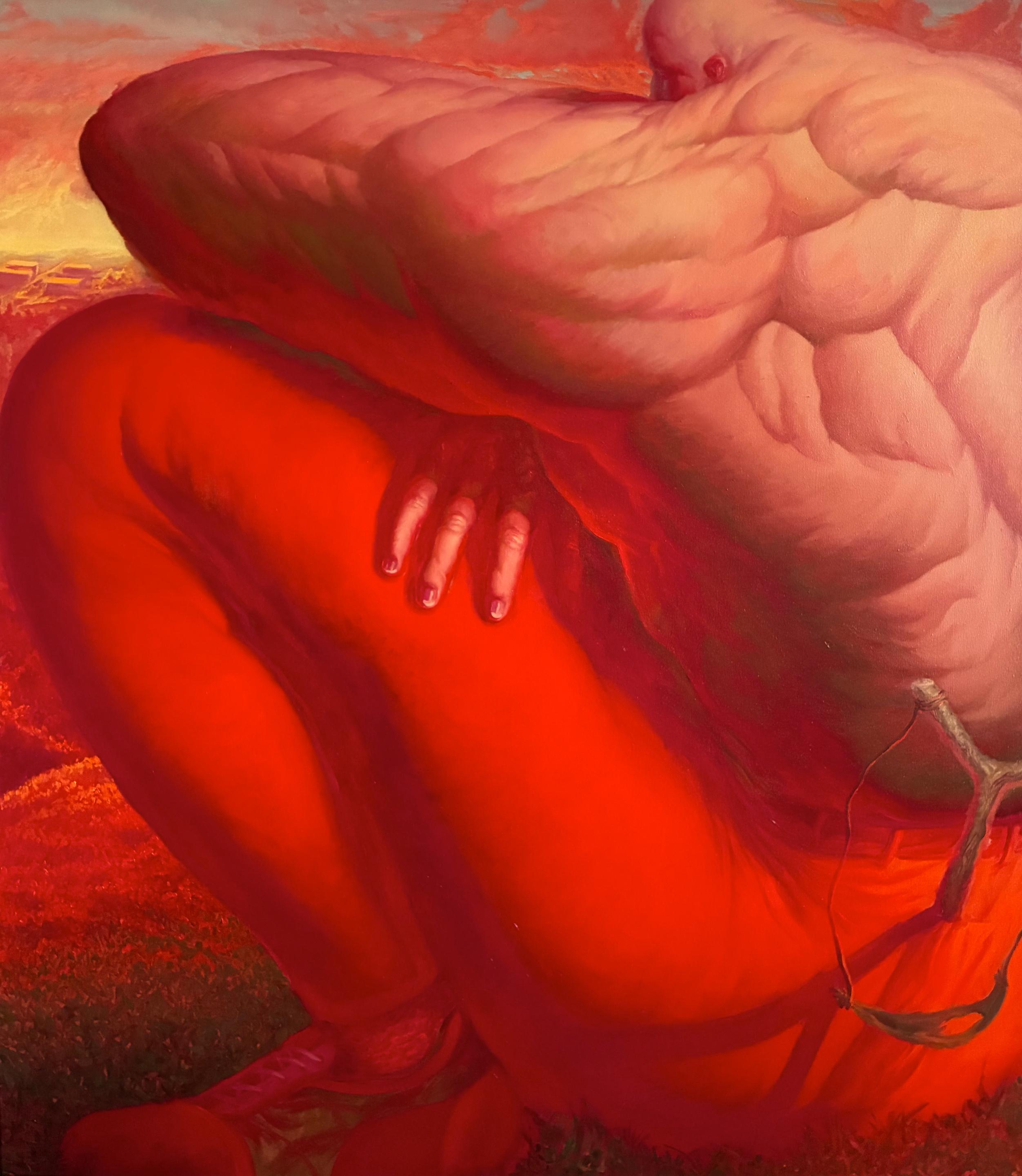
David’s Death
2026, acrylic and oil on canvas, 140 x 120
2018-2021, studied at FU OSU Ostrava in Painting Studio IV, led by Marek Meduna and Petr Dub; 2015-2018, at AVU Prague in Prof. Martin Mainer’s Painting Studio IV; 2012-2015 at FU Ostrava University in the Free Graphic Art Studio, led by M. Sibinský. 2013-2014, completed a study stay at the Jan Matejko Academy of Fine Arts in Krakow. 2008 - 2012, studied at the School of Applied Arts in Kremnica in the Department of Flat and Bulk Metal Engraving. 2018 and 2020, Studio MAL IV Prize at AVU in Prague. 2022, as a debutant took second place in the Painting Competition. 2023, 2024, 2025 and 2026, Competition finalist, receiving a Special Acknowledgement from the jury in 2025.
Samuel Kollárik has a long-term commitment to the artistic exploration of masculinity, most often in its toxic, stereotypical and socially conditioned forms. He approaches these issues symptomatically, with content and form creating a symbiotic union in his works. While his own experience is his point of departure, nonetheless his paintings reflect broader social mechanisms of how male identity is formed and how patriarchal models of behaviour take shape. Using hyperbolised male figures, grotesque situations and absurd humour, Kollárik uncovers the fragility of stereotypes that are outwardly presented as a manifestation of strength. Work with a deformed male figure, a rich narrative, well-considered composition, expressive and often unorthodox use of colour: these are characteristic features of his painting. Dynamic changes of perspective and scale enhance the grotesque character of his scenes, which balance between absurdity, irony and social criticism.
His final entry David’s Death (2026) develops the artist’s long-established interest in the mechanisms of power, masculinity, and patriarchal behaviour models. In this composition Kollárik withdraws from narrative positions and concentrates on portraying a large (corporeal) figure. Via a reinterpretation of the Old Testament story of David and Goliath, he reverses the familiar model of the victory of weaker over stronger. In Kollárik’s version Goliath wins, but he remains alone – without the opponent who has defined his strength. The artist explains, in the context of the work:“This story has become part of ordinary language, as the archetype of a struggle where, despite the enormous disparity in strength between the contenders, the weaker wins. But powerful people dominate the masses; the bigger swallow the smaller; the winner is he that has greatest strength: that is the statistical reality. Here we see Goliath after his victory. No miracle happens, and the ogre remains alone in a silent landscape. He loses his opponent, his significance, and his identity.” Kollárik thereby represents the archetype of force not as a triumph, but as an empty position, which without continual proof of its prevalence loses its meaning.
