View the online publication we released for the 20th anniversary of the painting competition Maľba.


1st place
Paula Gogola
(*1998, Banská Bystrica)
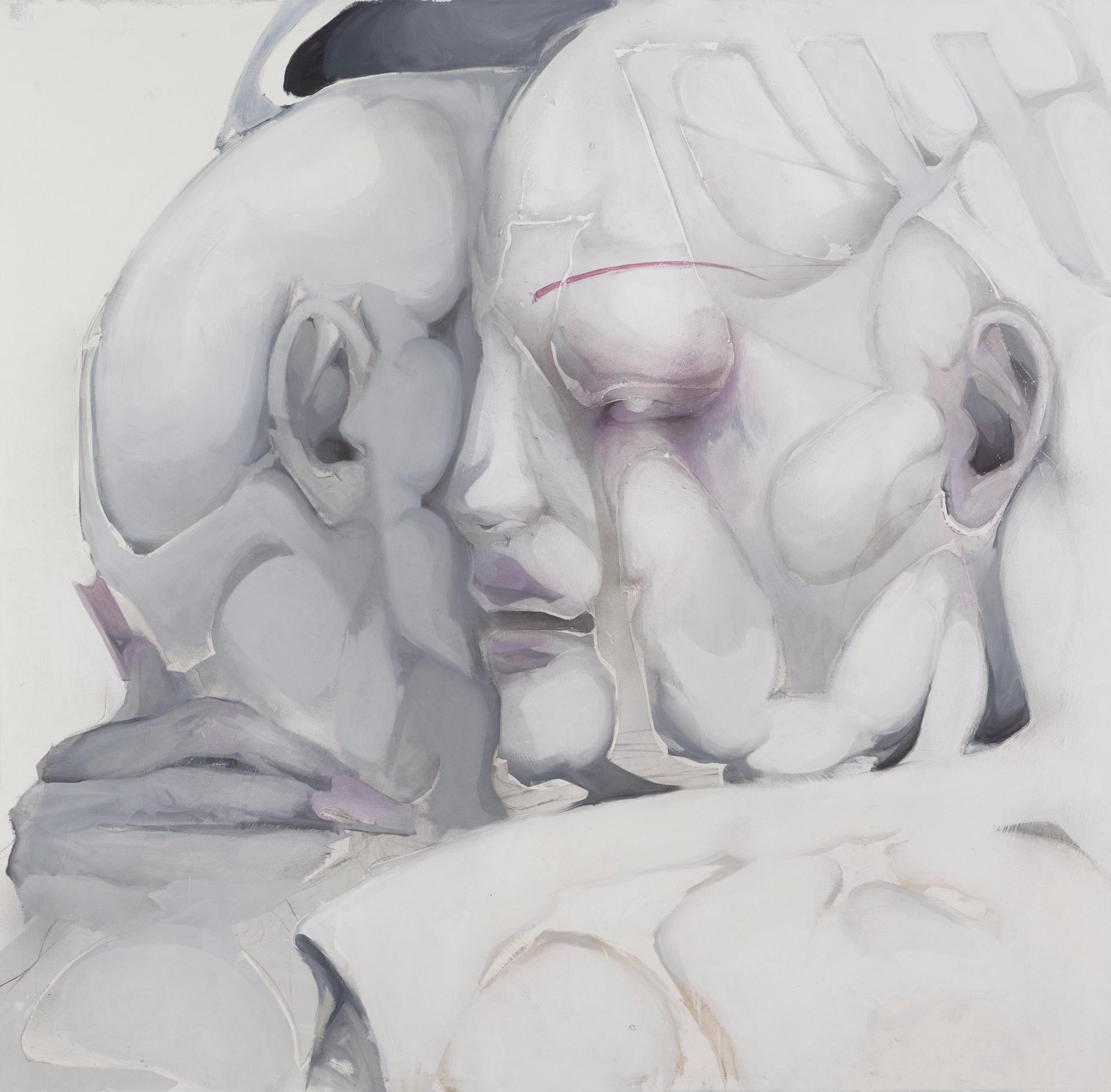
Limerence
2024, mixed media on canvas, 150 x 160 cm
2018 – 2022, studied at the Academy of Fine Arts and Design in Bratislava in Studio Mal+by, led by Klaudia Kosziba. From 2022 to the present day, has continued her studies at the Academy of Fine Arts in Prague, now in Studio Painting 3 under the guidance of Josef Bolf and Jakub Hošek. 2023 – 2024, concurrently studied at UMPRUM in Prague at the Sculpture Department, led by Dominik Lang, Tereza Jindrová and Amália Bulandrová. 2024, graduated from the Intermedia Department at UMPRUM, led by Michal Pěchouček and Dominik Gajarský. 2024 – 2025, studied at Mimosa Echard’s Studio at Beaux-Arts de Paris.
Paula Gogola is a visual artist who explores transgender identity and the body as a medium of social and individual experience. Her painting moves on the interface of abstraction and figuration, conceiving of the body as a plastic subject – shapable, multi-layered and rich in meanings – from inner processes to the social context of trans-feminine identity. Gogola examines corporality, the possibilities of modifying it, and playing with methods of constructing identity via mythopoetic narrative. She opens up themes of transgender, sexuality, social roles and cultural heritage. This artist’s early work focused on minimalist drawing – exploiting negative space, linearity and spontaneous gesture drawings. Gradually Gogola developed a radical synthesis of expressive means, where less is more: the pure composition creates a space for a deeper interpretive experience on the part of the viewer.
In Gogola’s final entry Limerence (2024) the face of the subject is presented with a cold, almost clinical precision, while its smooth surface suppresses explicit expression. This aesthetic reserve becomes the bearer of a hidden tension, an affect that is present but at the same time inaccessible. The portrait works ambivalently: it functions as a vessel of affect, conserving but not disclosing. With its reference to the iconography of the iron maiden (an anthropomorphic form serving for control and confinement), the portrait changes to an object of violence, in which the body becomes the bearer of an aesthetic and repressive function. The body is portrayed primarily as a substance whose potential to change its condition directly influences various levels of empirical reality. The work speaks of a very powerful, authentic and implacable corporal experience. Although the artist herself refers to the iron maiden, perhaps a reference to a cyborg would suit even better – in the context of defining the boundaries of ‘human’ corporality and what ‘escapes’ them... The title of the work evokes a psychological term which was first defined by the psychologist Dorothy Tennov in the 1970s: it designates an intensive, often obsessive state of being in love, or a powerful emotional inclination, accompanied by idealisation of the object of desire, emotional dependence, and a pressing need for reciprocity. This state is not merely a form of being in love, but a complex psychic phenomenon that oscillates between fascination and exhaustion.
(The text is from the catalogue for the competition Painting 2025, N. Gažovičová)
