View the online publication we released for the 20th anniversary of the painting competition Maľba.


Tóth Helen
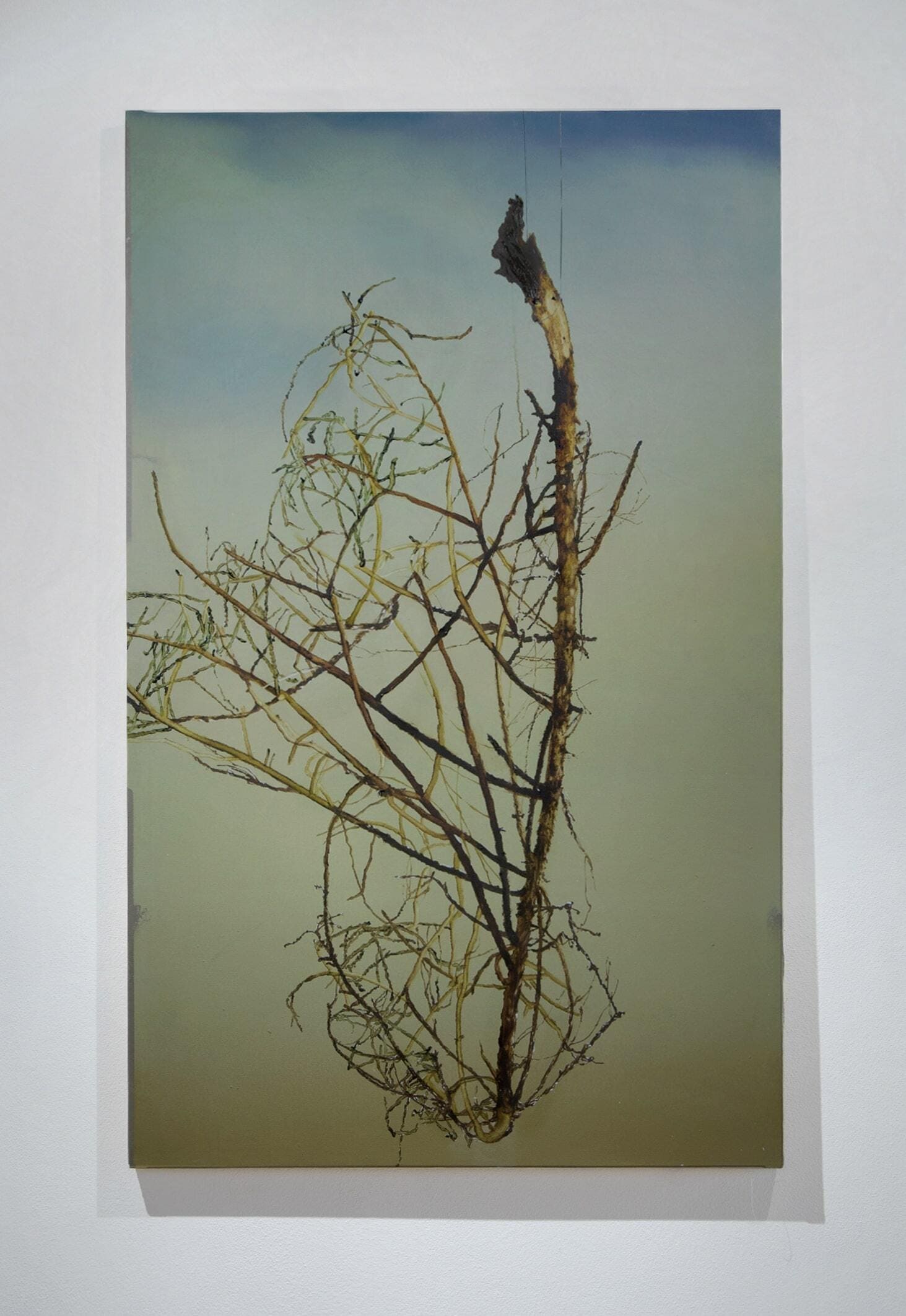
Visual representation of a painter's life
2023, oil on canvas, 140,5 x 84,5 x 4 cm
In the years 2012-2016, she studied painting and other media at the Academy of Fine Arts in Bratislava in the fourth studio of Professor Csudai. In the period 2016-2017, she continued her studies in the Studio +-XXI of Professor Fischer and in the years 2017-2018 in the painting studio Dvaja R Podhorského and M. Špirca. She is a multiple finalist in the Painting competition (2017, 2022 and 2023). She was nominated for the Piero D'Amore E Colore prize in Turin. and the longlist of the STRABAG Artaward International in Vienna. He lives in Dunajská Streda, creates in Bratislava's Nova Cvernovka. Helena Tóth's painting program is focused almost exclusively on depicting forest still lifes. However, the author does not paint them according to nature. She does not stick to the seen reality, there is no real image for her paintings. He creates forests in his painting studio, according to his own rules; regardless of fact. He reflects personal stories through painting. From their fragments, he creates a kind of imaginative forest - his own landscape, a private space for staging fragile moments, thoughts and desires, for which there is actually no place in ordinary life. Her main goal is to explore the boundaries of painting without a model - it is a challenge for her not to leave the studio, not to copy what has been given in advance, but to make do with her own fantasy about the (safe and fictitious) forest, which is so distant but close to her at the same time. Tóth's idea of the forest is an effort to penetrate deeply, into one's own interior. Its forests are always empty, unbounded, untouched, there are no people in them. He outlines them out of focus, vibrating; it lets the illusion of an atmospheric, indeterminate landscape come to the fore, seemingly inspired by nature, but actually living outside its rules. It is in this way that he creates a special, ideal environment for himself - a refuge. A place that is not threatened by external influences, but also by internal uncertainty. The final work Visual Representation of a Painter's Life (2021) depicts a specific branch that the author found in Horehroní. He admits to a fascination with a visually attractive object, but symbolically pushes his own preoccupation further. He uses it as a language through which he expresses serious thoughts. For her, the halúzka (almost a dry branch) symbolizes young artists who are active on the scene, have to manage the work of three people in one, often struggle with burnout, with a feeling of hopelessness and despair, with complete physical exhaustion. He points out that the amount of energy that artists put into their work and projects does not return in the same amount. Therefore, they often feel like a bare, dry branch hanging on a thin line. Naturally, in connection with this uncertainty and frustration, we cannot forget the term precariat ("precarious" and "proletariat"), which was first used by the French sociologist Pierre Bourdieu. The lack of social and financial stability is still one of the fundamental - negatively determining - factors of artistic operations."
