View the online publication we released for the 20th anniversary of the painting competition Maľba.


Kollárik Samuel
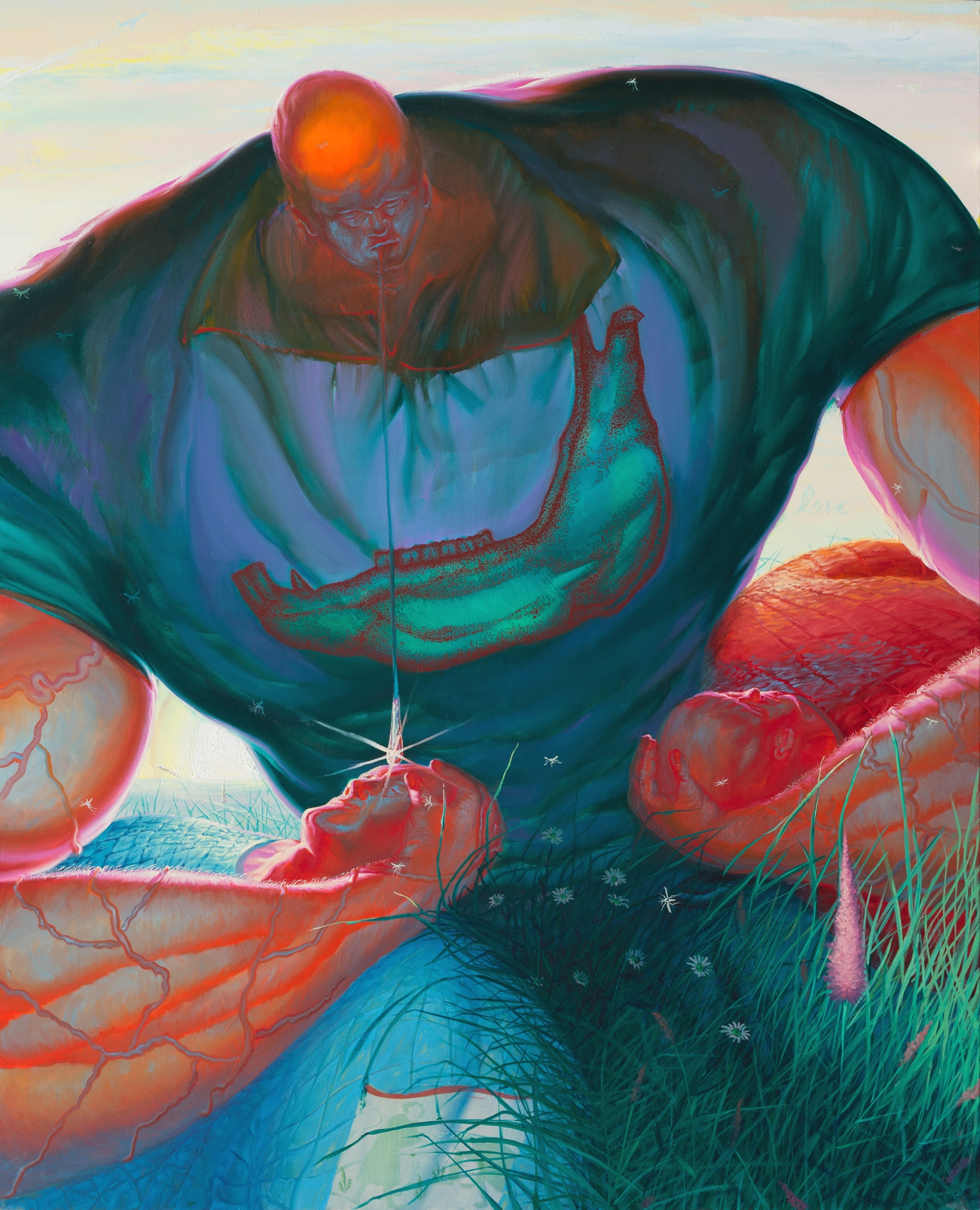
Gimme some life
2023, acrylic, spray and oil on canvas, 160 x 130 cm
In 2019-2021, he studied at FU OSU Ostrava, Painting Studio IV. Marek Meduna and Petr Dub, previously in the period 2015 - 2018 at AVU Prague in the Painting Studio IV. prof. Martin Mainer. In the years 2012 - 2015, he studied at the FU of the University of Ostrava in the Free Graphics studio under the guidance of M. Sibinski, and in parallel, in the period 2013 - 2014, he completed a study stay at the ASP named after Jana Matejki, Krakow in Poland. In 2022, as a debutante, he took second place in the Painting competition. Samuel Kollárik presents a clearly anchored and defined author's program. At a time when, in recent years, "women's issues", problems and topics were somehow "prioritarily" dealt with and are being dealt with, it is interesting, but also necessary, to see their less present but important counterpart today. Kollarik approaches this topic comprehensively - content and form are in symbiosis, he solves the problem long-term and emphatically. A strong point of his painting is the work with the figure and the rich narrative. It is also evidenced by his direct contact with the Czech environment, from which he distills a visual on the borderline between the grotesque and the absurd. His paintings are characterized by a bold handling of color, a specific and very expressive deformation of the human (male) figure, as well as a dynamic handling of changes in perspective and scale. The final painting Gimme Some Life (2023) belongs to a series of paintings subjectively exploring a wide spectrum of the dynamics of relationships between men. It again leads the author to masculine stereotypes. In the current painting, he tries to convey the experience of loss, departure, split, burnt bridges. From a reference to the history of painting (Cain and Abel) through kitsch and romanticism, it successfully reaches sincere (self) irony. He admits that he looks at the "problem" with a strongly rooted "Rambo" ethic - to the extent that denying it becomes an oxymoron. Despite this (or precisely because of this), Kollárik still finds a characteristic piece of humor in the given situation, necessary for the subsequent relativization. The result is a mockery of one's own short-sightedness and the grinding of the edges of kitsch into forms of sincere irony.
