View the online publication we released for the 20th anniversary of the painting competition Maľba.


Škorváneková Dominika
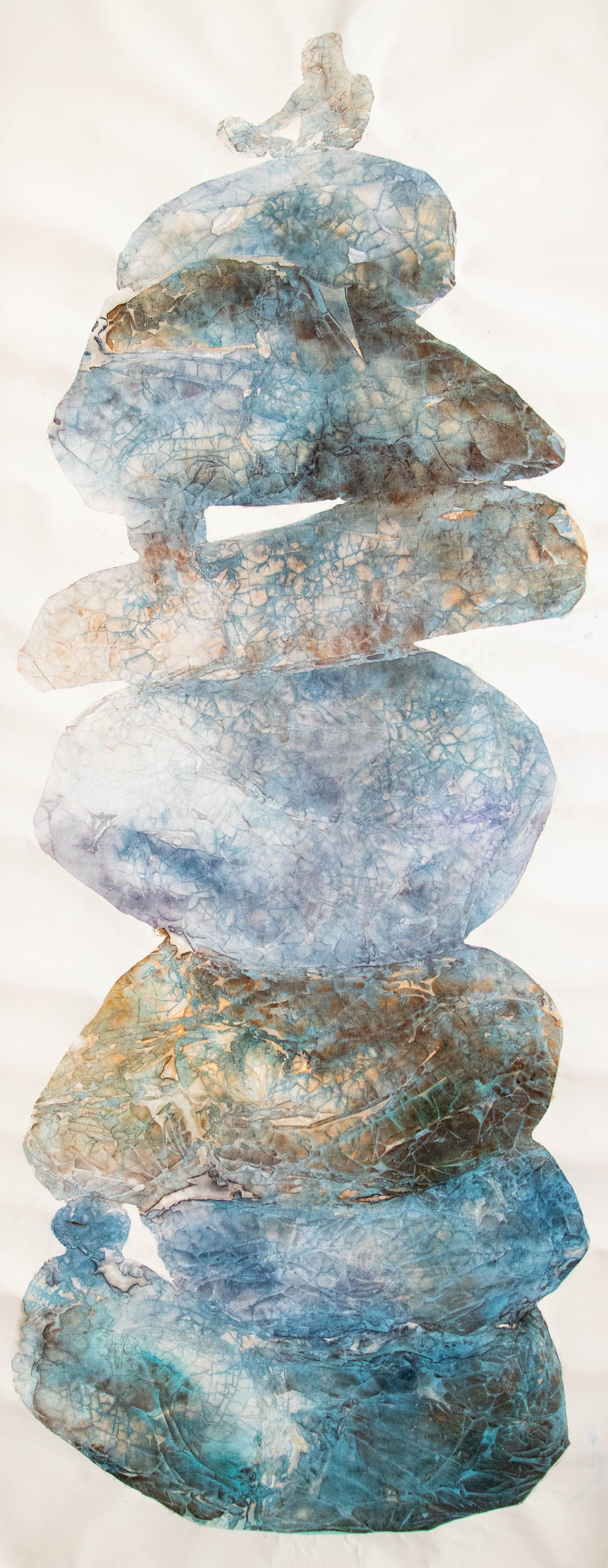
Cairn II.
2023, watercolor on canvas without adjustment to the blind frame, 200 x 80 cm
In the years 2017 - 2023 she studied at the Academy of Arts in Banská Bystrica at the Faculty of Fine Arts, in the Open Studio of Painting doc. During. She is active as an illustrator (e.g. magazine VERZIA 4/2022), creates original, hand-bound books, as well as objects made of paper material. He is also devoted to literary work and music - he composes simple piano songs inspired by nature. In 2022, her author's book Ghosts of one man was included among the most beautiful books in Slovakia. Through her work, Dominika Škorváneková mainly explores fragility and transience. That is also why he prefers to express himself with watercolor painting. This technique - its impermanence, changeability, delicacy, but also in a certain sense its inflexibility (self-drying, arbitrary formation of stains, processuality...) fascinates her. She focuses on simple motifs, in which she often interweaves natural structures with the motif of her own body (e.g. her bachelor's thesis Fragility, in which she dealt with the entanglement of women and the landscape). It is the author's need to empathize with the environment, to literally "dissolve reality" (transition of realistic depiction to abstraction), absolutely corresponds with her formal expression (fluid watercolor or ink painting). The subject of her interest is also silence, its light, ephemeral substance, the passage of time... She also thinks about the motif of emptiness and filling, layers and the changing landscape. Painting is alive and attractive to her; her creative process and potential represent exactly what interests and excites her - formally, technically, but also content-wise and emotionally. Final work Stone Mound II. (2023) brings a very personal, intimate testimony. Škorváneková is primarily poetic in her speech, her monumental watercolor paintings mainly depict the difficult-to-record transformations of the moment. In this case, her statement as a painter has the character of a self-portrait. It brings closer the experience of the death of the father. Recurring reflections on fragility and ephemerality are in clear symbiosis with the language of fluid painting. According to the author, white color refers to the feeling of being lost. Stones, on the other hand, serve to define the path - Jews place them on the graves of the deceased instead of flowers. It is remarkable how she depicts them - their structure has something organic, pulsating, human in it, as if the author herself were the stones... It is strange that just as water shapes a stone until it forms a pebble, washes it and grinds its edges; she participates and determines even in the painting process itself.
