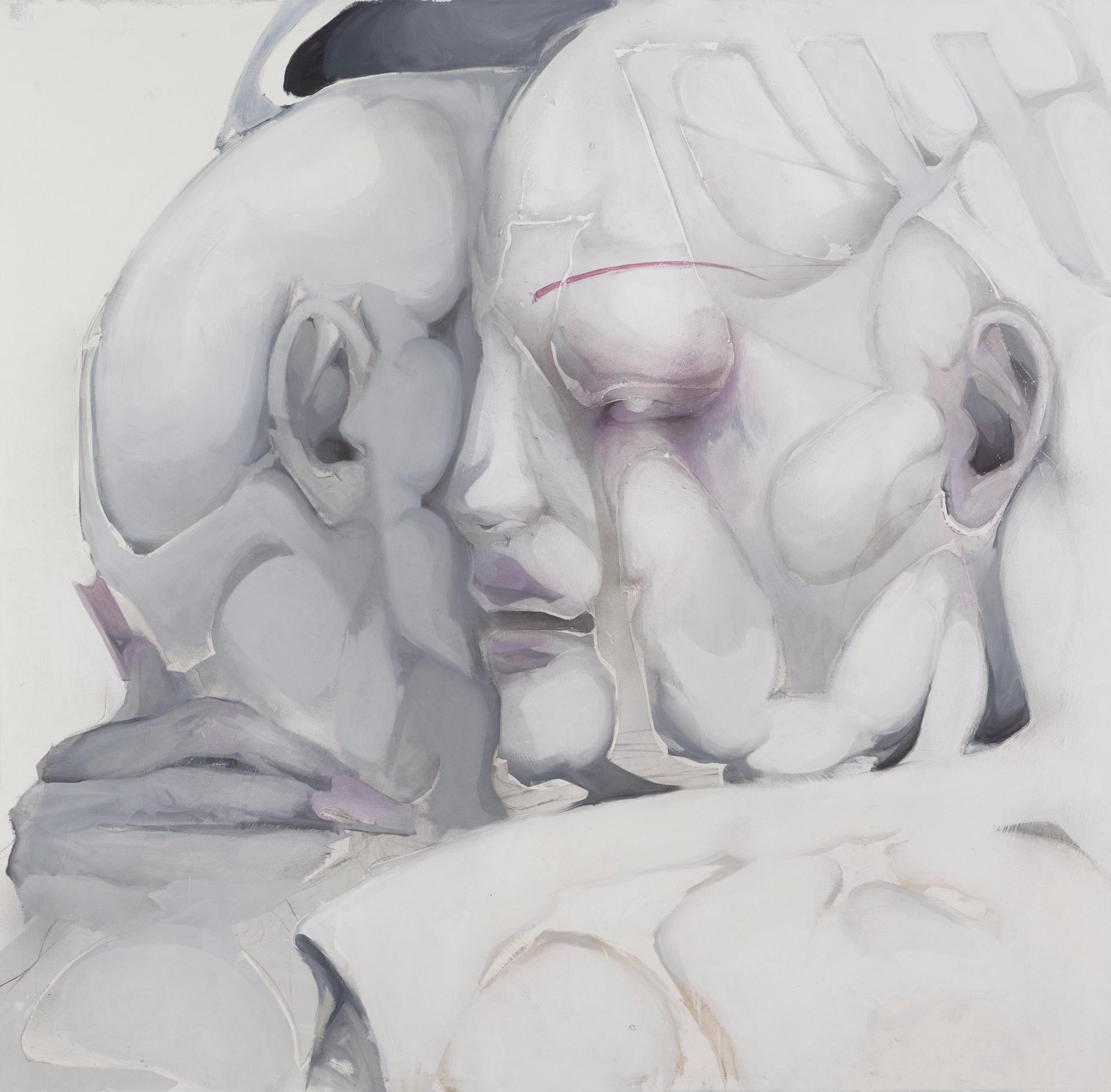

The Painting Competition Maľba – VÚB Foundation Prize for Painting for Young Artists created, between 2006 and 2025, both physical and media space to exhibit a total of 400 works reflecting the early creative output of 203 professional women and men painters. From this number of finalist works, 59 paintings were awarded by an expert jury, which convenes each year in a unique composition. The VÚB Foundation now presents these works in the cross‑sectional exhibition 20 Years of Maľba, which for the first time offers both professional and general audiences the opportunity to see the work of all competition winners together in one place.
Based on the jury’s selection, over the 20 years of the Painting Competition the VÚB Foundation has distributed a total of EUR 430,000 in awards supporting further artistic development to 29 women painters and 22 men painters. Through regularly organized free exhibitions and media communication, the Foundation provides encouraging feedback to all finalists while also bringing new impulses to the entire visual arts community.
Exhibition and Accompanying Activities Highlighting Young Art
Alongside the 20 Years of Maľba exhibition, which is open to the public with free admission from January 30 to March 1, 2026, at the Nedbalka Gallery in Bratislava, the VÚB Foundation—as the organizer of the competition has prepared several accompanying activities to mark this milestone anniversary. On February 5 at 5:30 p.m., a guided tour of the exhibited works led by Nina Gažovičová, a renowned expert in contemporary art and long‑standing professional curator of the Painting Competition, will be open to the public. Under the banner of the Painting initiative, an expert panel discussion featuring specialists from the Institute of Art History of the Slovak Academy of Sciences will also take place on February 12 at 5:00 p.m. at the Nedbalka Gallery, open to those interested in the development and direction of modern visual art in Slovakia. Visitors can also look forward to the exhibition finissage on March 1 at 3:00 p.m., featuring a guided tour with the curator as well as the painters whose works are on display.
Translation of accompanying texts from the exhibition:
Refuge
(identity – body – corporality – subject)
On Painting
Painting is a medium that with striking sensitivity, though sometimes reconditely and indirectly, speaks out on urgent personal and social themes. It functions as a mode of examining one’s own identity; it is an instrument for working with memory, revision of historical narratives, or working through individual and also collective traumas. Frequently the relationship of artists to their own identity is formed, or arrives at its ongoing revaluation, via painting. That is true on a general level (Šušovicová – domestic stereotypes) as well as on a purely personal, intimate level (Bátorek – childhood in a housing estate in the 1990s, Fabian – growing up and coming to terms with a career break-point, Hrehová – personal maturing, Kollárik – exploration of (toxic) masculinity, Sabová Džuppová – motherhood, family). The body is not just a motif of self-awareness, delight and sensual experience (Janečková Walshe, van Hettmer) but also an important bearer of memory, vulnerability or subjective experience (Kováčiková –violence against women, Polák – eating disorders). Among finalists in recent years there is a clear prevalence of themes of corporality (Kontroš, Gogola), being an outsider, gender and queer identity (Dúbravský). This confirms that, far from closing itself to the world that surrounds it, painting is actively entering into dialogue with the world and becoming a space where strong and generationally shared messages are sounding clearly.
On Painting
The survey exhibition XYZ. The Painting Competition Across Three Generations summarises twenty years of support by the VUB Foundation in the field of contemporary painting. It presents all of the laureates, in total 49 artists and one art duo, who have been honoured during the past two decades by international juries in Painting –VUB Foundation Prize for a work of painting for young artists.
Ranking of the artists is deliberately intuitive. Aside from the purpose of accentuating a certain similarity of themes and approaches, the main aim of the laureateship was to mix the generations and disturb chronological classification, which (particularly in the first years of the contest) could be seen as excessively emphasising the dominance of one centre (Bratislava). What has resulted is an impartial, non-hierarchical view that enables parallel reading of individual artistic positions with stereotypes or geographical preferences.
The exhibition is part of a celebration of the successful course of the Painting project. It calls to mind the results of the long-term support of visual art which VUB Foundation is systematically developing, currently with a third generation of young painters. During this time the competition has become a permanent component of the Slovak cultural scene, an event that is respected and expected, and not only by those competing. Each year it is a worthy celebration of the painting medium, as well as a space for the necessary confrontation with the expert opinion of an international jury. For the artistic community, at a time when many of the pillars of our ecosystem are literally crumbling, it represents an important continuity and a significant encouragement. It remains a safe space, where creativity and opinion are respected and where no one’s voice is ruled unworthy to be heard.
Language
(gesture – trace – plot – symbol)
On painting
Painting is a visual language that communicates by means of gesture, stain, colour or trace. Its meaning does not emerge via an unambiguously constructed statement, but rather in complex interaction (art history, artist and his/her programme, viewer...). Over the past twenty years, the most varied registers have been represented in the competition. The plurality of approaches confirms that painting is capable of appropriating diverse strategies and paths without losing its autonomy. In the 21st century also it functions as a medium that is able to make contact and convincingly mediate meanings, while at the same time creating a space for individual interpretation. This openness is what gives it continuing relevance and the ability to communicate even in the visually saturated milieu of our present day.
The present collection of works enables us to look within painting as an open system and consider the spectrum of its possibilities. It confirms that the medium is not a closed compilation, but rather operates with a flexible language which it constantly changes, re-evaluates, expands, and adapts to the age in which the given work originates. The meaning of the painting does not relate only to its visible content but arises in tension between that which is depicted and that which is only hinted at or suppressed. The artists are developing an autonomous painterly language, which reflects contemporary strategies and context as well as their personal stances. Some works emphasise the spontaneity of the gesture (Činčalová, van Hettmer), others, by contrast, thoroughgoing systematic work and absolute technical perfection (Šille, Vasilko). Many operate with a transcription of reality (Bartošová, Czinege), with visual metaphor (Mrvová), or using wit (Slaminka) or the emotional impact of colour (Pascoe Mikyšková). Often there are overlaps with other media, for example film and photography (Červenková, Mojšová) or drawing (Garová). Some rouse interest by a striking individual signature based on a personal mythology (Sabová, Ďžuppová) or on an artistic sytem (van Hettmer).
On Painting
In the first years of the competition (the zero years) painting was above all a question of language, a search for pictorial possibilities in direct confrontation with photography and the digital model. (Here it was in harmony with the preferences of the jury and the context of the time.) Primarily painting was presented as a flat, formally definite medium, reflecting the setting from which it derived. It functioned especially as an instrument for coming to terms with new forms of visuality: photography, virtual image or monitor screen. Confrontation with technology played a key role in forming generational identity, while at the same time laying the basis for strategies that continue to this day in contemporary visual art. Some older artists bordering the age limit, or with different points of departure in painting, do appear in the selected Top 20 (e.g. Marko Blažo, Denisa Lehocká, Dorota Sadovská), but in the final analysis they have remained rather in the background.
View
(space – landscape – setting – place)
Painting naturally turns outward also, beyond the inner world and experience of its creator, to the world that surrounds us – to space, landscape and a broader environment. Hisorically it has functioned as an instrument for knowing reality and recording its changes, a medium of perceiving the world. Even today painting helps us to grasp reality, to deepen experience and emotional life-history, and to draw attention to subtle – often overlooked – shifts in the relationship between the subject (I) and the outer world. In the present-day world it is no longer merely a matter of precisely mediating reality, but especially of its interpretation, where the confrontation of personal experience with the outer structures of the world comes to the forefront. Thanks to the heightened interest which painters devote to their surroundings, the environment in their works seems like an alternative space, which enables the viewer to feel and reflect on phenomena and situations that frequently evade everyday attention.
The painting often functions as a mediator of imaginative space (Bôrik, Podhorský, Žirková), of the artist’s appropriation of reality (Tallová), or of its complete transformation (Fazekašová). Painting, however, is not only a sensitive register which accentuates the beauty of everyday things (Florek, Kollár); it is also a report on the everyday world’s changes, and an instrument of analysis that enables disclosure of the mechanisms by which the world is visually organised (Jarotta). It becomes a critical designation of the relationship between human being and landscape (Baník), including ecological and environmental themes (Navrátil, Sandanus). At the same time, however, it may highlight the loss of contact with the real world and reflect the enclosure, constriction or isolation of the human being, who is withdrawing to the ‘safe’ space of virtual reality and anonymity (Sandanus).
On Painting
The competition as such is not just a formal mechanism of the selection of finalists and laureates. Each year it creates a plural (and in many respects, also a safe) environment, which supports the development of individual painterly approaches. Painting is founded on the expert opinions of respected professionals, whereby a high degree of independence and transparency of decision is guaranteed. The four-member jury is composed of representatives of various spheres: practising painters, art historians, also representatives of galleries, collectors and teachers. For a number of years now the rule has applied that only one member of the jury (and generally not the president) represents Slovakia. This principle helps to eliminate local connections and lowers the risk of bias in the evaluation process. In other words, jurors from abroad will approach the works without prejudices, having no regard for conventional preferences or local reputation. Furthermore, the very things that may be overlooked or depreciated in the local milieu, or that the artist himself or herself lacks belief in or inwardly doubts, may be exalted as merits. The competition therefore functions as a space for experiment, where artists may test and confirm their own positions – often also in relation to the educational or institutional background from which they are emerging.
Method
(experiment – process – overlap – material)
On painting
The final selections by the international jury regularly include works with which the public finds it difficult to make contact, often rejecting or even disparaging them. This automatic (so to speak) revulsion derives from expectations that are made of painting as a medium – assumptions that still endure, although they have long been obsolete. The task of art, however, is not to mediate aesthetic value in the sense of ‘beauty’ or formal perfection. Such a constricted understanding of art reduces the real potential of artistic practice and fails to see its true function or value. In reality, these works are well thought through, and they reflect on the conditions of production of the painting or the processes shaping its resultant form. Experiment, processuality, and emphasis on the material, push painting beyond the limits of ‘traditional’ form and open it up by overlapping with other media such as sculpture and object.
The relevance of these departures is confirmed by the fact that as many as five of the winning works may be assigned to this ‘experimental’ category. These artists are only apparently moving on the plane of abstraction, as it may seem to a viewer who has no knowledge of the deeper context. In their works they conduct a dialogue directly with art history (Koszorús, Valík); they develop artistic strategies focused on borders and redefining painting as a medium (Cvik, Dubová, Oleňová, Šuranská). Work with unorthodox materials (Šimonová), instruments and technological procedures (Šoltis, Demjanovič and Mitríková), serves not as a formal experiment but as an analytical tool for examining the potential of painting. The spectrum of approaches moves from reflexive strategies in a personal (Zatvarnická), painterly (Hrachovinová, Tóth), or even conceptual register, in which the actual process, gesture and material become bearers of meaning.
On Painting
In its earliest years the competition was closely linked to the existing third-level art centres: the Academy of Performing Arts in Bratislava, the Technical University in Košice, and the Academy of Arts in Banská Bystrica. Their status on the scene was formed by a different historical context and pedagogical background, and furthermore by a hierarchy which was dominated at first by our capital city. The competition thus functioned also as a space for symbolic appraisal or deepening of the relationship between centre and periphery, where regional affinity was also explicitly a counterweight against the marginalisation of locations outside of Bratislava.
The gradual stabilisation of conditions, as well as the increasing mobility of students, disrupted this model, however. Experience of stays and residencies abroad came to the forefront, weakening the originally ‘high-tension’ power play between Bratislava, Banská Bystrica and Košice (though a certain natural measure of healthy rivalry endures to the present day). Painting has gradually ceased to be linked with the signatures of specific schools and has become a more open field. The painting is no longer merely a technical or formal problem; far more often it appears as a space for intense thought or for technological or material experiment. In the final selections, thanks to the greater differentiation of opinion in the jury, new tendencies ever more frequently win affirmation: expressive and more narrative registers, and also deconstruction of the medium itself, especially via expanded forms and border-crossing ventures to the object or installation.
