View the online publication we released for the 20th anniversary of the painting competition Maľba.


Denis Braun
(*2000, Bratislava)
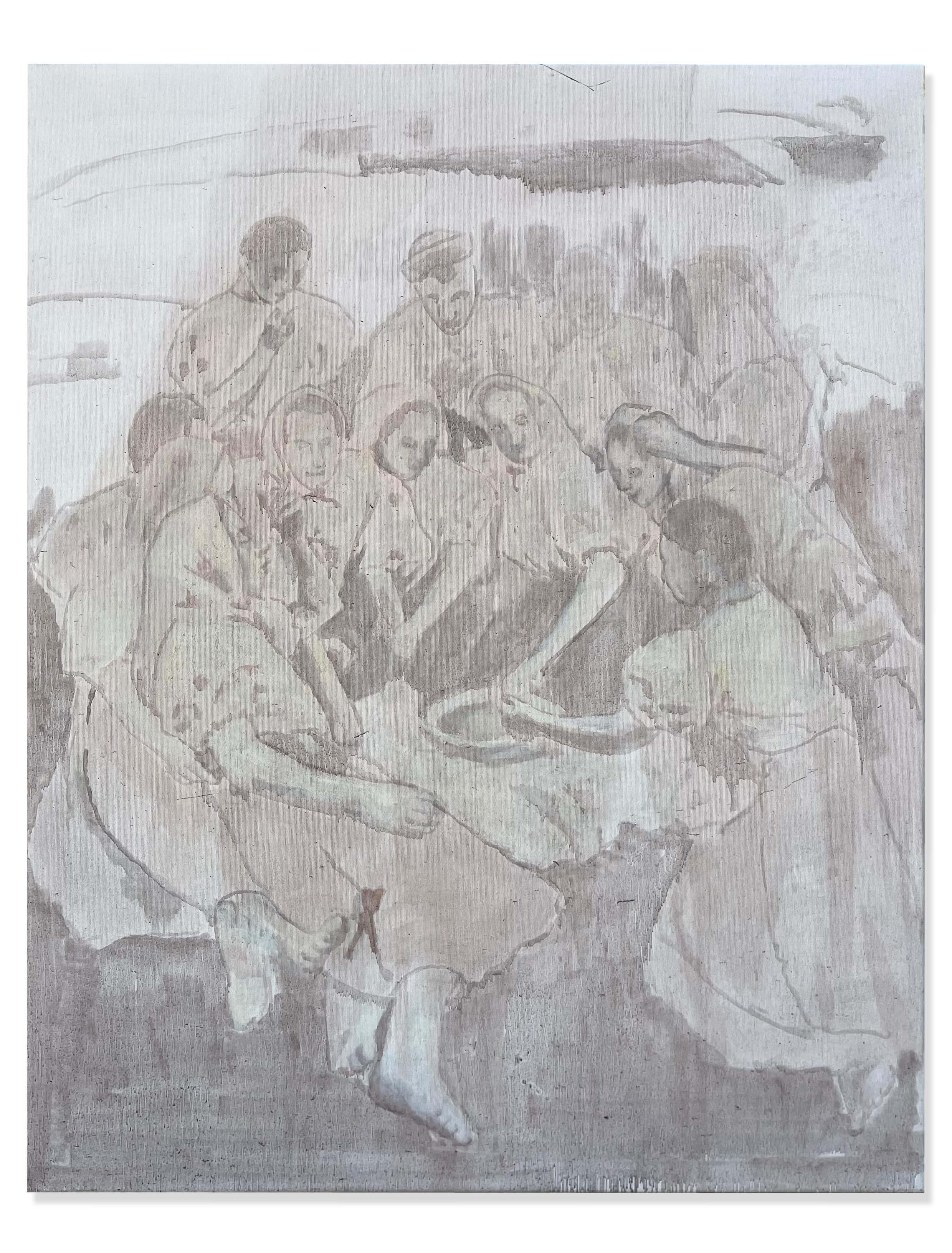
Peasants Eating Pigeons
2024, oil painting, acrylic, bleach, 100 x 80
2020 – 2026, studied painting at the Academy of Fine Arts and Design in Bratislava, in the Painting Studio led by Doz. Klaudia Kosziba. 2026, finalist in the Painting Competition.
Denis Braun, a debutant in the competition, works principally in the media of painting and drawing, which he uses as an instrument for critical reflection on contemporary reality. He addresses social, existential and cultural themes. Characteristic of his art is a conscious detachment from familiar stereotypes and modes of thinking, and a search for authentic space beyond normative structures. He responds to current (social and political) affairs not directly but via visually layered situations, open to diverse interpretations. Important in his artistic approach is work with the exhibition space, which he considers not a neutral background but rather an active element, co-creating the meaning of the work. Braun thereby extends the potential of painting towards spatial and environmental installations. His visual language typically shows a reduced, often monochromatic painting, with emphasis on materiality and processuality (work with destruction and renewed construction of the painting). Motifs of liminality and absurdity, and symbolic tension between past and present, recurrently appear in his artworks.
His final entry Peasants Eating Pigeons (2024) is based on transformation of a photographic record to a painterly language. The artist constructs an indefinite ‘interspace’ without stable temporal and spatial identity, where the motif gradually dissolves, to the point of losing its distinctness. Via reduction, Braun tests the limits of the painting medium. Peasants Eating Pigeons indirectly works with the tradition of our historical figural painting (Benka, Hála), while deliberately weakening its representative function. The original monumentalising tendency of that period (stressing colourful costumes, the hard-working Slovak people...) is disrupted by gradual blurring of the original motif. Chemical interventions on the painted surface weaken the period stylisation; the painting loses its narrative quality and changes to a space of uncertainty and oppressiveness, where only a trace of the original scene remains. Braun examines how historical paintings and their ideological significations remain in the collective visual memory, and he offers a critical reinterpretation of the pictorial archetype. His work thematises liminality and atavism as states of transition, return, and abiding indefiniteness. By desaturation and removal of colour, he weakens the original meaning of the motif and lets its ambivalence appear.
